4-4-2 vs 4-3-3: Which Formation Fits Your Team?
A tactical breakdown of 4-4-2 vs 4-3-3 — structure, strengths, weaknesses, and how to pick the right system for your squad.
Picking a formation isn’t just about filling in a diagram — it decides how your team defends, how it moves the ball forward, and how much running you’re asking specific players to do every match. The 4-4-2 and the 4-3-3 sit on opposite ends of that trade-off: one favors structure and directness, the other favors possession and rotation.
Here’s how the two systems actually differ on the pitch, where each one breaks down, and how to map them out yourself using our free football lineup generator.
Midfield Shape: Flat Line vs. Triangle
The clearest difference between the two formations shows up in central midfield.
| Tactical Element | 4-4-2 | 4-3-3 |
|---|---|---|
| Midfield structure | Flat line of four (2 central, 2 wide) | Triangle of three (1 pivot, 2 advanced) |
| Defensive shape | Two compact banks of four | High front three, fluid midfield block |
| Passing patterns | Direct, along the wings | Diagonal, through the half-spaces |
| Width | Traditional wingers, overlapping fullbacks | Inverted wingers or overlapping fullbacks |
| Strikers | Partnership of two | Lone striker flanked by inside forwards |
A flat 4-4-2 is easy to coach because responsibilities are linear — everyone has a clear lane. A 4-3-3’s staggered triangle does the opposite: it creates two diagonal passing options for almost anyone on the ball, which is why it holds up better against pressure.
The 4-4-2: Built on Balance
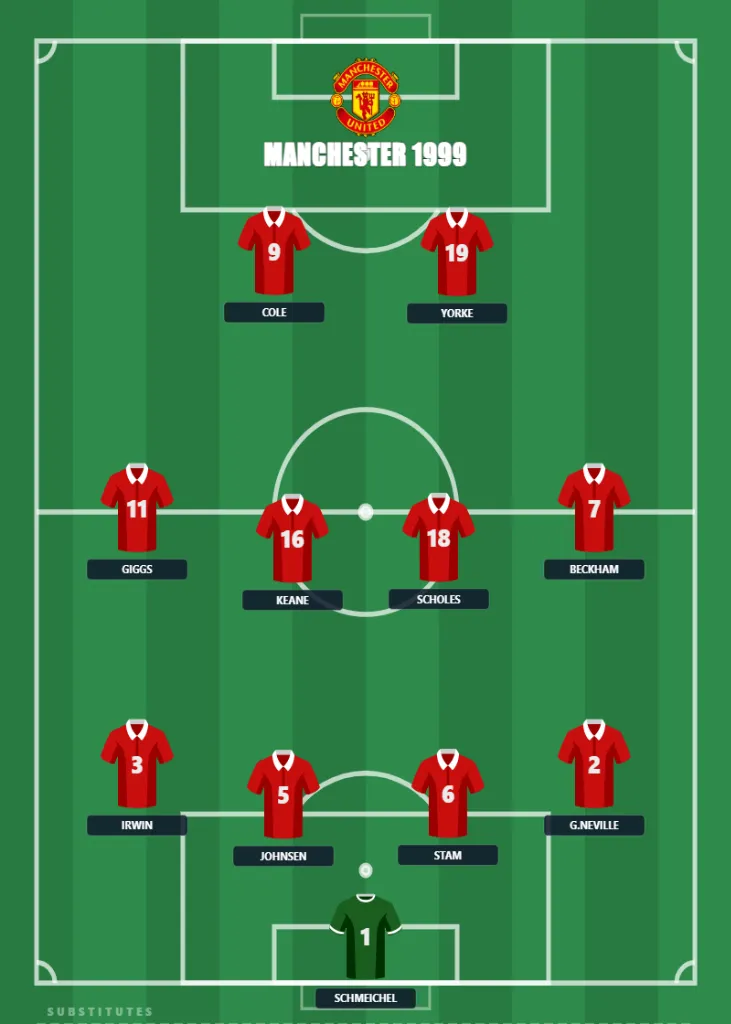
The 4-4-2 was the default formation in world football for decades — Arrigo Sacchi’s AC Milan and Sir Alex Ferguson’s treble-winning 1999 Manchester United both ran variations of it. It splits the pitch into three clean layers: back four, midfield four, two strikers.
Defending. The midfield four tucks in tight with the back four, keeping the gap between lines under 10–15 meters so opponents can’t easily find space between them. The two strikers lead the press, angling the opposition’s build-up toward the touchline rather than through the center.
Attacking. The front two usually split roles — a target man who wins headers and holds the ball up, and a second striker who reads the knockdowns and runs beyond the defense. Wingers stay wide and cross into the box, backed up by overlapping fullbacks.
The weak point is the two-man midfield. With no third body in the center, both players have to cover enormous ground box-to-box, which becomes a problem against any side that can overload the middle.
We can visualize this iconic setup using our online football lineup generator to map out the starting eleven and substitute players:
The 4-3-3: Built on Possession
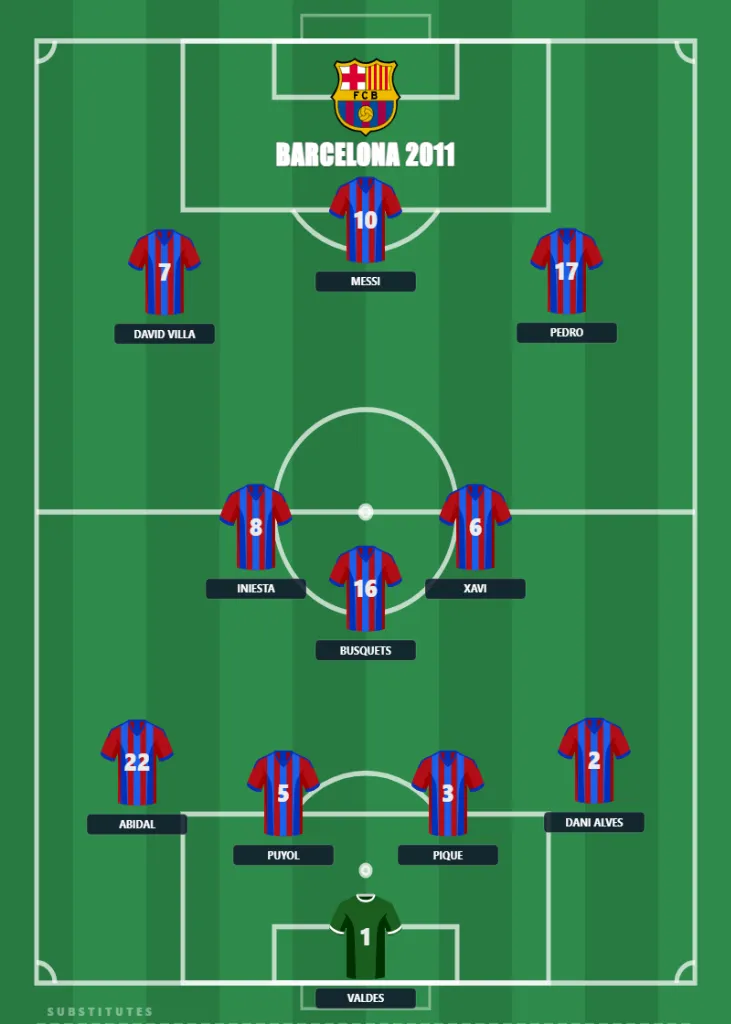
Rinus Michels’ Total Football, Guardiola’s Barcelona, and Klopp’s Liverpool all built their identity around the 4-3-3. It pairs a back four with a three-man midfield and a front three that rotates constantly.
Midfield. One holding midfielder (the pivot) shields the back line and recycles possession; two more advanced midfielders push into the half-spaces to overload the edge of the box.
Attack. Wingers often cut inside onto their stronger foot instead of hugging the touchline, leaving the flank open for the fullback to overlap. The center forward can drop into midfield as a false nine, dragging a center-back out of position and opening a lane for a winger’s run.
The trade-off is what happens in transition. If both fullbacks are forward when possession is lost, the space behind them is wide open — the pivot and center-backs need to be quick to cover that ground before the opponent can break.
Using our free squad builder online, we can model this legendary possession engine:
What Happens When One Plays the Other
Put a 4-4-2 against a 4-3-3 and the tactical battle comes down to three things.
Midfield numbers. The 4-3-3 has three central midfielders against the 4-4-2’s two, so it’s a 3v2 in the middle by default. A 4-4-2 side usually has to drop one striker deeper to even the numbers — effectively becoming a 4-4-1-1 without the ball — or ask the wide midfielders to tuck in, which costs them width.
The wide areas. A 4-4-2’s winger-fullback pair faces a winger and an overlapping fullback from the 4-3-3. If the winger cuts inside and the wide midfielder doesn’t track back, the 4-3-3’s fullback gets a free run down the line.
Patience vs. directness. A compact 4-4-2 block is hard to break through the middle, so the 4-3-3 has to shift the ball side to side to stretch it. When the 4-4-2 wins the ball back, its best option is usually a direct pass into the space behind the 4-3-3’s high fullbacks.
Which One Should You Use?
- Go 4-4-2 if you have two strikers who complement each other, disciplined wingers who track back defensively, and central midfielders with the engine to cover box-to-box. It’s also the faster formation to teach a new squad.
- Go 4-3-3 if you have a defensive midfielder who can anchor the center alone, creative players who thrive in tight half-space areas, and quick wingers who win 1v1s. It’s the better choice if your priority is controlling matches through possession and pressing high.
Build and Compare Both Formations
Our free football lineup creator runs entirely in your browser - no signup, no watermark — so you can map out either formation and compare them side by side.
- Pick a formation. Select 4-4-2 or 4-3-3 from the dropdown; player positions snap onto the pitch automatically.
- Set your kit. Choose a Plain, Striped, or Collared jersey style and set your club colors, including a separate design for the goalkeeper.
- Fill the roster. Add names and numbers in the Squad tab, plus up to 9 substitutes for the bench.
- Adjust positioning. Drag any player to fine-tune spacing — push a fullback higher, tuck a winger inside, whatever your tactic needs.
- Draw your tactics. Switch on Pen Mode to sketch runs, passing lanes, or defensive zones directly on the pitch.
- Export. Download a standard or high-res (2x) PNG of your finished lineup card to share with players or post online.
Running a small tournament to test these formations against each other? Our free tournament bracket maker can organize the matches. For a broader walkthrough of the tool, see our guide on creating football lineups.
FAQ
Is 4-3-3 better than 4-4-2? Neither is objectively better — it depends on your players. 4-3-3 tends to suit teams built around possession and pressing; 4-4-2 suits teams that want defensive solidity and a direct attack with two strikers.
What formation beats a 4-3-3? A well-organized 4-4-2 or 4-5-1 can trouble a 4-3-3 by matching its midfield numbers and hitting the space behind its attacking fullbacks on the counter.
Why did 4-4-2 fall out of fashion at the top level? Elite teams shifted toward formations with an extra central midfielder, like the 4-3-3 and 4-2-3-1, because a two-man midfield struggles against sides that consistently overload the center of the pitch.
Can I switch between 4-4-2 and 4-3-3 during a match? Yes — many coaches change a striker’s role or push a winger into midfield to shift shape without making substitutions. Practicing both structures with your squad makes that switch easier to execute.