How to Create Football Lineups: Formations, Tactics, and the 1986 Argentina Blueprint
A comprehensive guide on creating visual football lineups. Learn how to map formations like 4-4-2, customize kits, and explore Argentina's historic 1986 World Cup tactics.
Visualizing a team’s layout is the first step in successful match preparation, whether you are coordinating a local amateur squad or analyzing professional matches. To help with this, using a digital football lineup generator provides coaches, players, and tactics enthusiasts with an interactive canvas to arrange players, design kits, and draw plays.
Instead of relying on clunky graphics software or physical clipboards, a modern squad builder runs directly in your browser, allowing you to instantly export high-resolution team sheets. This guide will walk you through who benefits from lineup creators, break down the mechanics of core football formations, and analyze the revolutionary 3-5-2 blueprint that led Diego Maradona and Argentina to World Cup glory in 1986.
Who Benefits from a Visual Squad Builder?
A tactics board is more than just a list of names; it is a communication tool. Several groups use these digital layouts to streamline their workflows:
- Amateur and Youth Coaches: Communicating complex positioning to young or amateur players can be challenging. A visual layout helps players understand their spatial responsibilities, transition phases, and defensive boundaries.
- Local League Managers: For weekend leagues or five-a-side kickabouts, managing who starts and who sits on the bench is a weekly puzzle. Sharing a clean, professional lineup card via group chat reduces pre-match confusion.
- Tactical Writers and Bloggers: Analysts require high-quality pitch diagrams to illustrate team structures, passing networks, and defensive blocks in their articles.
- Gamers and Fantasy Managers: Whether planning a FIFA Career Mode rebuild or visualizing a Fantasy Premier League starting eleven, a soccer squad builder lets you map out your dream team.

Decoding Classic Formations: 4-4-2, 4-3-3, and Beyond
Formations dictate how a team occupies space. No single layout is perfect; each offers distinct trade-offs between defensive solidity and attacking numbers.
The Traditional 4-4-2: Balance and Structure
For decades, the flat 4-4-2 was the default setting in global football, particularly in the UK. It divides the pitch into three clear blocks: a back four, a midfield four, and two strikers.
- Defensive Strength: The system is highly structured and easy to coach. When defending, the team forms two compact banks of four, leaving very little space between the lines.
- Attacking Mechanics: Attack relies on winger acceleration and cross delivery. Usually, one striker acts as a “target man” to win aerial duels, while the second striker hunts for second balls.
- The Weakness: Modern possession teams can easily overrun a two-man midfield. If the opposing team plays a three-man central midfield, they will enjoy a numerical advantage in the center of the park.
The Modern 4-3-3: Possession and Width
Popularized by teams like Barcelona and Ajax, the 4-3-3 is the preferred choice for possession-oriented clubs. It features a defensive anchor in midfield supporting two creative, advanced midfielders, flanked by wide wingers.
- Positional Triangles: The three-man midfield naturally creates passing triangles, making it easier to keep possession and play out from the back.
- High Pressing: With three forwards occupying the opposition backline, the 4-3-3 is ideal for pressing high up the pitch to force turnovers near the opponent’s goal.
- The Weakness: The fullbacks must carry immense physical demands. They must push forward to support the attack while recovering quickly to defend empty space behind them.

Historical Masterpiece: Argentina’s 1986 World Cup Blueprint
In the summer of 1986, Argentine coach Carlos Bilardo faced a massive tactical dilemma. He possessed the most talented player in the world, Diego Maradona, but traditional formations either restricted Maradona’s movement or left the team defensively vulnerable.
Bilardo’s solution was a revolutionary tactical shift that changed international football forever: the introduction of a flexible 3-5-2 formation.
Freeing Diego Maradona
Prior to 1986, almost all elite teams utilized a back four. Bilardo realized that by dropping a central midfielder into a permanent “sweeper” role and narrowing his fullbacks into center-backs, he could defend with a back three. This allowed him to flood the midfield with five players.
This five-man midfield was not designed for possession, but for protection. Bilardo selected hard-working, defensive-minded midfielders like Sergio Batista, Ricardo Giusti, and Héctor Enrique. Their sole job was to win the ball, cover lateral spaces, and immediately pass to Maradona.
With a three-man defense and a wall of midfielders behind him, Maradona was relieved of all defensive duties. He was given a completely free “number 10” role, roaming behind striker Jorge Valdano.
The Visual Field Layout
Using our visual editor, we can map out this historic squad’s exact starting positions from their legendary tournament run. Notice how the shape shifts from a defensive block to a wide midfield web:
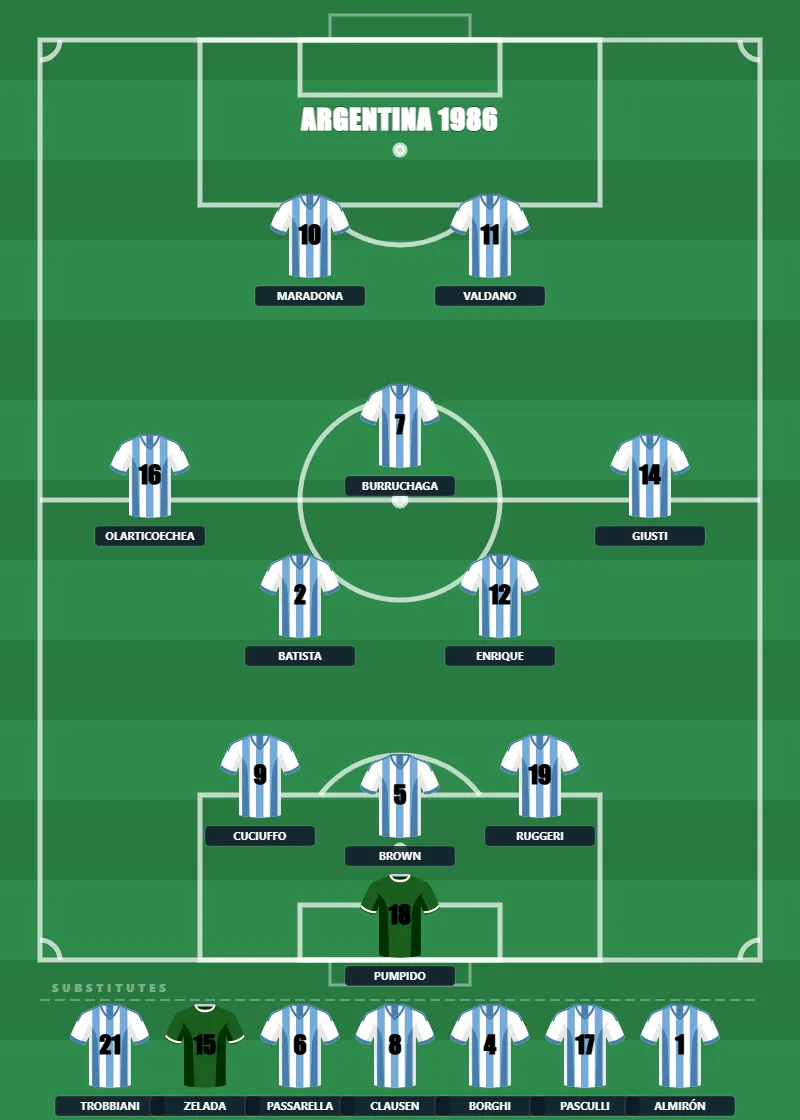
Key elements of this classic blueprint include:
- José Luis Brown (Sweeper): Sat behind Oscar Ruggeri and José Luis Cuciuffo, cleaning up long balls and organizing the offside trap.
- Wing-backs (Giusti & Olarticoechea): Covered the entire length of the flanks, dropping deep to form a five-man defense when under pressure.
- Jorge Valdano (Target Man): Played as the focal point, pinning the opponent’s center-backs to create pocket spaces for Maradona to exploit.
According to historical records preserved in the FIFA World Cup Archives, Bilardo’s tactical shift was initially heavily criticized by the Argentine press. However, the system proved unbeatable, culminating in a dramatic 3-2 victory over West Germany in the final, cementing this 3-5-2 blueprint as one of the greatest tactical innovations in football history.
Step-by-Step: How to Design Your Team Sheet Online
If you want to map out your own team’s tactics, design a legendary historical lineup, or share a fantasy squad, you can use our free football formation creator to do so in minutes.
Step 1: Select Your Tactical Base
Open the soccer squad builder and use the sidebar dropdown to choose your formation. The tool supports classic configurations like 4-4-2, modern variations like 4-2-3-1, and historic three-back setups like 3-5-2. The player jerseys will instantly snap into position on the digital pitch.
Step 2: Customize Your Team’s Kits
Utilize the custom football jersey creator settings to design your outfield kits:
- Choose between Plain, Striped, or Collared jersey templates.
- Pick your club’s primary and secondary colors using the color selectors.
- Set a distinct design and color scheme for your goalkeeper jersey to match real-world matchday requirements.
Step 3: Manage Your Player Roster
Switch to the Squad tab to edit player information:
- Change shirt numbers and names to match your squad.
- Add up to 9 substitute players to populate the bench at the bottom of the field.
- Drag and drop players directly on the pitch to adjust spacing, create asymmetric tactical shapes, or swap starters with bench players.
Step 4: Draw Tactical Runs and Instructions
Toggle the Pen Mode on the drawing toolbar to turn the pitch into an interactive tactics board online. Draw arrows to indicate passing lanes, run directions, or defensive zoning. You can choose custom stroke colors and widths, and easily undo mistakes.

Step 5: Export and Share Your Sheet
Once your board is ready, click Download PNG or High-Res PNG (2x) to save your custom lineup card. The image is rendered entirely in your browser using vector graphics, ensuring sharp text and clear details suitable for printouts or social media uploads.
Conclusion: Visualizing Victory
Tactical diagrams are a staple of modern football because they translate abstract strategic ideas into clear visual cues. By leveraging an interactive squad builder, you can save hours of design work and create team sheets that look professional and clean.
Ready to build your team’s tactical board? Head over to the Football Lineup & Formation Creator to select your formation, customize your team kit, and export your matchday card today.